
Why Your Brain Overthinks Before Sleep: The Science of Bedtime Rumination & How to Quiet It
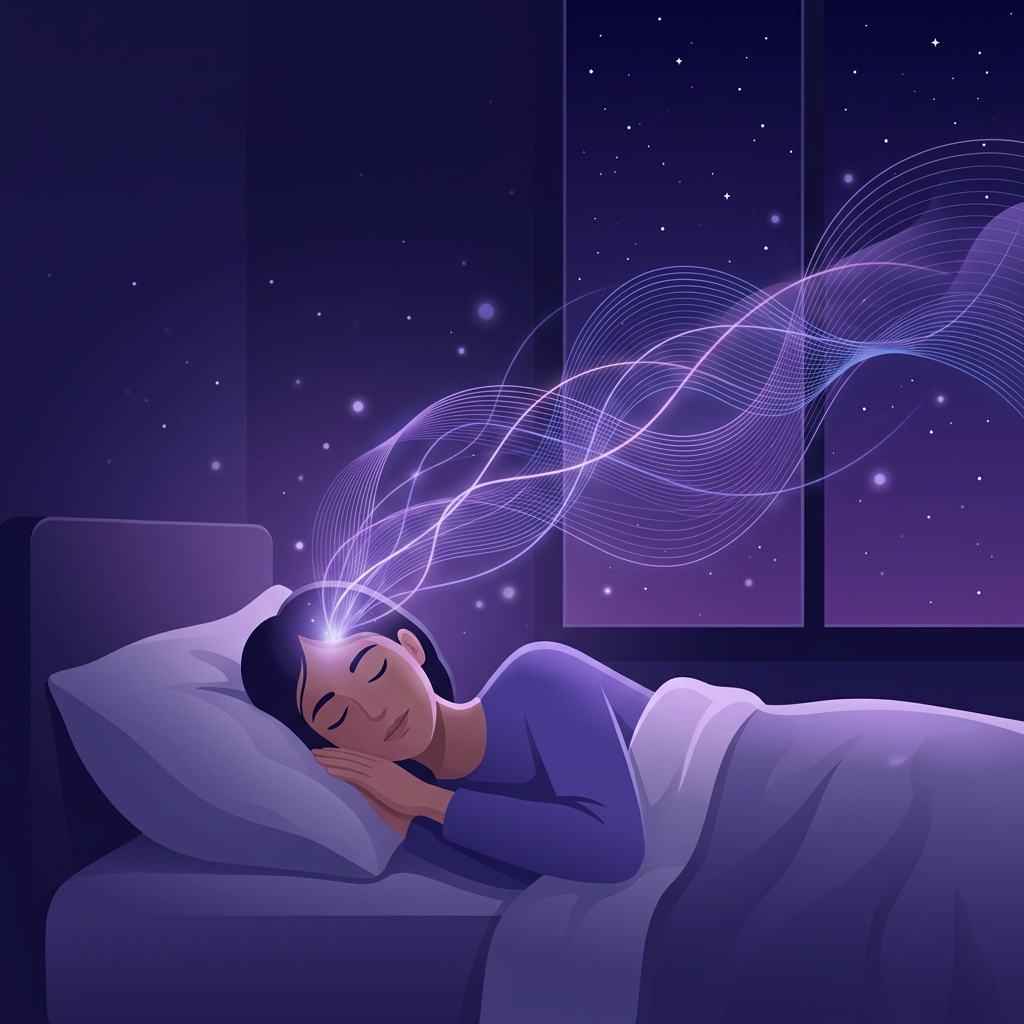
You did not plan to spend the next ninety minutes replaying an awkward remark from a staff meeting earlier today. You were not intending to calculate catastrophic worst-case scenarios about an upcoming project. You brushed your teeth, got under the covers, and simply wanted to sleep.
And yet here you are at 11:45 PM, eyes staring at the ceiling, brain fully illuminated, interrogating every unresolved detail of your life. The unanswered email. The difficult conversation you have been avoiding. The decision you have postponed.
This is not a character flaw, and it does not mean your mind is broken. There is a precise, well-documented neurological mechanism that explains why your brain waits until you lie down in the dark to turn its volume all the way up. Understanding this mechanism allows you to disarm bedtime rumination with clinical precision.
(Note: If you fall asleep easily but frequently jolt awake between 2:00 AM and 4:00 AM with an elevated pulse and physical adrenaline, that is a physiological circadian cortisol surge rather than cognitive sleep-onset rumination. Read our companion guide on Waking Up at 2 AM with Anxiety.)
What Actually Happens in Your Brain When the Lights Go Out
During daytime hours, your brain is tethered to external sensory inputs. Commuting, responding to Slack notifications, processing emails, and conversing with colleagues keep your attentional networks directed outwardly. Your brain has specific external tasks to consume its cognitive bandwidth.
The moment external stimuli disappear — which is precisely what occurs when your bedroom lights turn off and the room falls silent — a specialized neural circuit takes center stage: the Default Mode Network (DMN).
1. Default Mode Network (DMN) Hyper-Connectivity
Discovered by neuroscientist Dr. Marcus Raichle in 2001, the Default Mode Network comprises interconnected regions (including the medial prefrontal cortex and posterior cingulate cortex) that activate whenever you are not engaged in an active external goal.
The DMN is the brain's internal narrative engine. It constructs your sense of self, re-examines past social interactions, projects future threats, and analyzes social status. Research published in SLEEP demonstrates that dysregulated hyper-connectivity in the DMN is directly correlated with pre-sleep cognitive arousal and subjective insomnia. When external distractions vanish, the DMN steps into the vacuum, turning ambient silence into an echo chamber for self-referential thought.
2. Prefrontal Hypometabolism (The Loss of the "Rational Brakes")
Throughout waking hours, your prefrontal cortex (PFC) acts as an analytical filter, contextualizing minor worries, assessing objective probabilities, and providing logical reassurance. However, the prefrontal cortex is metabolically demanding. By late evening, glucose metabolism in prefrontal regions decreases significantly as your brain conserves energy for sleep.
The consequence is profound: your emotional limbic system (which processes fear and vigilance) remains active, while your rational prefrontal brakes have clocked out for the night. A problem that you would effortlessly solve with perspective at 2:00 PM suddenly feels catastrophic at 11:30 PM.
3. The Zeigarnik Effect (Unclosed Cognitive Loops)
First identified by psychologist Bluma Zeigarnik, the brain possesses an innate drive to retain uncompleted tasks in active working memory until they reach resolution. When you go to bed with open loops — unanswered messages, incomplete chores, unaddressed emotional tensions — your subconscious continues pinging your working memory, attempting to solve tomorrow's dilemmas without the resources to take action.
Productive Daytime Planning vs. Unproductive Bedtime Rumination
Recognizing the difference between genuine problem-solving and toxic bedtime loops is essential for cognitive defusion:
| Dimension | Productive Planning (Daytime) | Bedtime Rumination (Nighttime) |
|---|---|---|
| Cognitive Goal | Formulating concrete, actionable next steps | Repetitively re-running catastrophic scenarios |
| Physical State | Calm, focused, prefrontal logic engaged | Elevated heart rate, muscle tension, restlessness |
| Emotional Outcome | Sense of clarity, closure, and resolution | Escalating dread, helplessness, and self-blame |
| Action Capability | Immediate ability to send an email or make a list | Lying trapped in bed with zero behavioral outlets |
| Thought Structure | Linear, progression-oriented ("Step 1, then Step 2") | Circular, repetitive loop ("What if... but why did I...") |
| Effective Response | Taking action or scheduling task on calendar | Cognitive defusion, worry windows, & brain dumping |
4 Evidence-Based Tools to Quiet Bedtime Overthinking
Traditional advice like "just relax and clear your mind" typically triggers the Ironic Process Theory (the harder you try to suppress a thought, the more dominant it becomes). Instead, use these structured behavioral interventions:
1. The 15-Minute Scheduled Worry Window (CBT)
Scheduled worry time is one of the most effective interventions in Cognitive Behavioral Therapy for anxiety:
- Designate 15 to 20 minutes in late afternoon (e.g., 4:30 PM to 4:50 PM) as your official "worry window."
- Sit with pen and paper and deliberately write out every pressing anxiety, project obstacle, and feared outcome.
- When that exact same thought resurfaces at 11:30 PM, you have an objective, practiced response: "This thought has already been logged. It has an official appointment tomorrow at 4:30 PM. I am not allowed to litigate it in bed."
2. The Bedside "Brain Dump" Externalization
Keep a notebook or journal on your bedside table. If racing thoughts circle repeatedly, turn on a dim lamp and write them out raw — unedited, unorganized, and unfiltered. Externalizing thoughts changes how the brain holds them. When thoughts remain purely cognitive, your DMN treats them as urgent survival data that must not be forgotten. Seeing the sentence in physical ink provides your brain with a tangible "closure signal." For structured prompts that help you know exactly what to write, see the guide on journaling prompts for anxiety. You can also explore Sukoon's private mood reflection journal for structured, judgment-free emotional logging.
3. Cognitive Defusion (Acceptance & Commitment Therapy)
In ACT, overthinking worsens through cognitive fusion — treating your catastrophic thoughts as objective realities. Practice cognitive defusion through linguistic distancing:
- Instead of thinking: "I am going to completely fail my presentation tomorrow."
- Reframe silently: "I am noticing that my mind is offering me the thought that I will fail tomorrow." This simple semantic shift creates immediate psychological space between your conscious awareness and the automated chatter of your Default Mode Network.
4. Somatic Grounding and the 5-4-3-2-1 Sensory Anchor
To pull attention out of the abstract DMN loops and back into the physical present, practice the 5-4-3-2-1 grounding method in bed:
- Notice 5 things you can feel (the texture of the sheets, the weight of your blanket, the coolness of the pillowcase, your hands resting on your stomach).
- Notice 4 subtle sounds in the room (the hum of the fan, distant traffic, your breath, the house settling).
- Notice 3 physical sensations inside your body (chest rising, shoulders releasing, jaw unclenching).
- Take 2 slow diaphragmatic breaths with an extended exhale.
- Name 1 intention for sleep ("My only job right now is to rest.")
Frequently Asked Questions
Why does overthinking always feel so much worse in the dark?
In the dark, external sensory competition drops to zero while your prefrontal cortex operates at reduced metabolic capacity. You experience the raw emotional weight of worries without the rational perspective-taking and probability assessment that normally soften them during daylight hours.
Can journaling right before bed actually make anxiety worse?
If you use bedtime journaling to deep-dive into complex traumatic wounds or attempt to solve intricate relationship crises, it can increase emotional arousal. However, a structured "brain dump" — simply listing tasks, unresolved items, and quick bullet points — consistently shortens sleep-onset latency by offloading working memory.
What is the difference between bedtime rumination and 2 AM waking anxiety?
Bedtime rumination occurs during sleep onset, where your Default Mode Network struggles to transition from daytime vigilance to sleep. In contrast, 2 AM waking anxiety occurs after you have already fallen asleep, typically triggered by nocturnal cortisol spikes, sleep architecture shifts, or blood sugar dips. For middle-of-the-night awakenings, read our 2 AM Awakening Guide.
How does conversational reflection help quiet the racing mind?
Cognitive loops persist because unexpressed thoughts encounter zero friction in the mind. Putting words to thoughts — whether speaking aloud, writing in a journal, or interacting with an empathetic companion like Sukoon — forces abstract dread into concrete sentences, which are naturally easier for the brain to process and release.
Sukoon is an evidence-informed AI companion grounded in CBT, ACT, and DBT reflection frameworks. It is designed for daily emotional self-reflection and stress reduction, not as a replacement for medical therapy or psychiatric diagnosis. If sleep difficulties persist for more than one month, consult a licensed healthcare professional.
Your brain is still running. Let Sukoon help you slow it down.
Private, judgment-free CBT-based conversations to help you externalize thoughts and break the loop.